


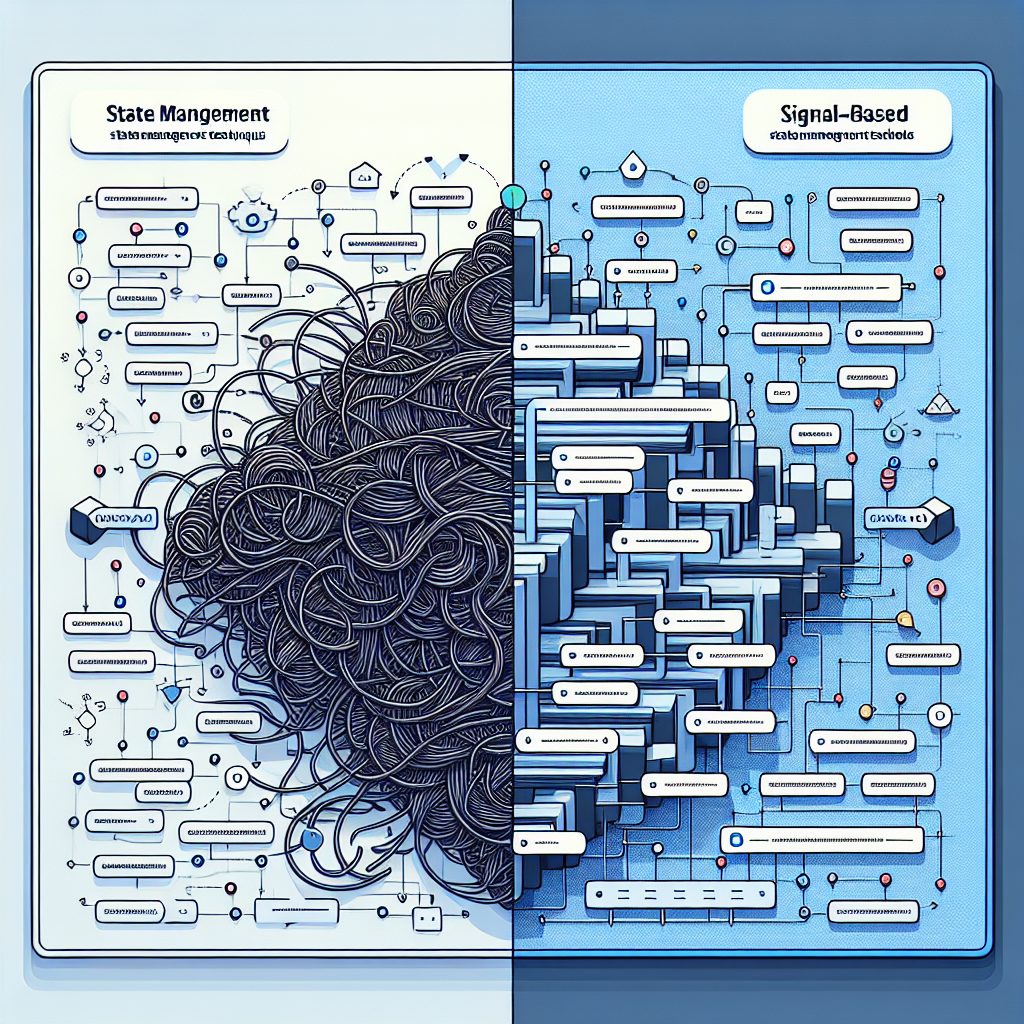
Defining State Management
State management is essential in modern web applications, particularly for frameworks like Angular. It involves the methods and practices used to handle the state of an application, maintaining integrity, performance, and enhancing user experience. As applications grow, tracking changes and data flow becomes crucial, making robust state management strategies necessary.
Traditional State Management Approaches
Historically, Angular developers relied on services and RxJS for state management. Services allowed for shared data across components, while RxJS introduced the use of Observables and Subjects to manage application state reactively. NgRx, inspired by the Redux pattern, provided a more structured approach, enabling a global state store.
Understanding RxJS Observables and Subjects
Observable streams in RxJS allow developers to handle asynchronous data. When an application state changes, components depending on that state can re-render seamlessly. Subjects, a type of Observable, enable pushing new data into the stream, making them useful for user-driven events.
Architectural Patterns: Flux and Redux
Flux and Redux became mainstream companion architectures for state management, offering unidirectional data flow. While they provide elegance and predictability, using these patterns can introduce complexity, particularly in smaller applications where service-based states might suffice. This complexity can lead to a steep learning curve for new developers.
Emerging Paradigms: Signals in Angular 14 and Beyond
With the introduction of Angular 14, new paradigms have shifted traditional reactions to state changes through a feature known as signals. Signals simplify reactivity, reducing boilerplate code and providing a fresh way to manage component states without the overhead of a global store.
Trade-offs of Different State Management Methods
Choosing the right state management technique involves examining several trade-offs:
- Performance Implications: Global stores can lead to unnecessary re-renders. Signals enhance performance by allowing localized state management without impacting the entire application.
- Developer Experience: While NgRx and Redux offer structured patterns, they often require extensive boilerplate, which can hinder productivity.
- Tooling and Ecosystem: Solutions like NgRx come with robust tooling, whereas simpler service-based state management can be more flexible but may lack comprehensive support.
Common Misconceptions
One prevalent misconception is that a global store is mandatory for all applications. In many cases, localized state management is sufficient and can streamline performance. Developers should assess application needs before deciding on a comprehensive state management solution.
Real-world Applications and Code Examples
Implementing state management effectively requires an understanding of Angular’s dependency injection and its changes post-2023. Below is a simple demonstration of using signals and services for state management:
import { Injectable, signal } from '@angular/core';

@Injectable({ providedIn: 'root' })
export class StateService {
  private counter = signal(0);

  increment() {
    this.counter.set(this.counter() + 1);
  }

  getCounter() {
    return this.counter;
  }
}
This example highlights how signals can manage a counter state within an Angular service, showcasing the reduction in boilerplate while maintaining reactivity.
Evaluating Application Performance
To assess the performance of your current state management approach, consider metrics like component re-render frequency, API call rates, and user experience feedback. Poor state management can manifest in slow application responses or unwanted UI flickering.
Conclusion
In conclusion, understanding state management in Angular is crucial for developing efficient applications. Whether leveraging traditional approaches or adopting new paradigms like signals, developers must adapt their strategies to meet application demands. By recognizing trade-offs and addressing common misconceptions, you can fortify your application’s integrity and enhance user experience.
