


Introduction
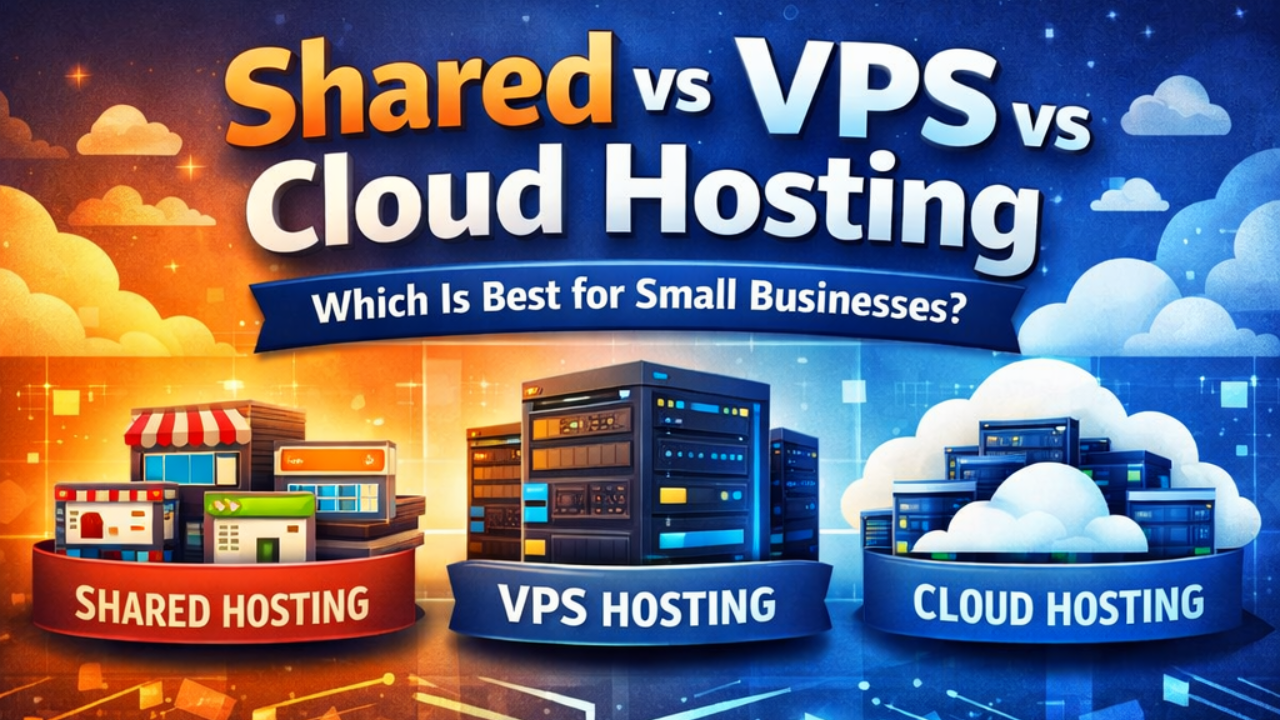
Shared vs VPS vs Cloud Hosting is one of the most confusing decisions for small business owners when launching a website. Choosing the wrong hosting type can lead to slow performance, unexpected downtime, or unnecessary costs. In this guide, we compare Shared Hosting, VPS Hosting, and Cloud Hosting in detail to help small businesses choose the best solution based on budget, performance, scalability, and future growth.
What Is Web Hosting?
Web hosting is a service that stores your website on servers connected to the Internet, making your site accessible to users around the world. Each type of hosting differs mainly in resource allocation, performance, and scalability.
Shared Hosting – Best for Beginners on a Budget
Overview:
Shared hosting hosts multiple websites on the same server, with each site sharing storage, memory, and CPU resources.
Pros:
- Most affordable hosting option
- Easy setup and server maintenance handled by provider
- Ideal for simple sites, portfolios, or starters
Cons:
- Limited performance during traffic spikes
- Shared resources can lead to slower page loads
- Less control over server configuration
📍Best For: New small businesses with low traffic and limited budgets.
VPS Hosting – Great Balance of Power & Cost
Overview:
Virtual Private Server (VPS) hosting gives you a virtual server within a larger physical server. Each VPS has dedicated resources that aren’t shared with others.
Pros:
- Better performance and reliability
- Dedicated CPU, RAM, and disk space
- Higher control and customization options
Cons:
- Slightly higher cost than shared hosting
- Requires more technical know-how (depending on plan)
📍Best For: Small businesses growing their traffic, e-commerce stores, and sites needing more performance and flexibility.
Cloud Hosting – Scalable & Reliable
Overview:
Cloud hosting uses a network of virtual servers rather than a single physical machine, distributing resources dynamically to handle load.
Pros:
- Excellent scalability for traffic surges
- High uptime due to distributed infrastructure
- Pay-for-what-you-use pricing flexibility
Cons:
- Can be more expensive for predictable workloads
- Some plans require technical management skills
📍Best For: Businesses expecting rapid growth, fluctuating traffic, and high reliability requirements.
Side-by-Side Comparison
| Feature | Shared | VPS | Cloud |
|---|---|---|---|
| Cost | Least expensive | Mid-range | Varies with usage |
| Performance | Basic | Good | Excellent |
| Scalability | Limited | Moderate | Very high |
| Control | Low | Medium | High |
| Ideal For | Small sites/blogs | Growing businesses | Fast scaling & mission-critical websites |
Which is best ?
- Choose Shared Hosting if you are just starting out and cost matters most.
- Go with VPS if you need performance and control without breaking the bank.
- Opt for Cloud Hosting if scalability, uptime, and future growth are priorities.
Interest in Cloud & DevOps ? Click here to view more articles

2 Comments
Hey there! I know this is somewhat off-topic but I needed to ask.
Does managing a well-established website like yours take a
large amount of work? I am completely new to operating a
blog but I do write in my diary every day. I’d like to start a blog so I will be able to share my personal experience
and thoughts online. Please let me know if you have any kind of ideas
or tips for new aspiring bloggers. Appreciate it!
If you are really passionate in writing blogs your own website, there are lots of videos in youtube about how to setup blog website. Once you did the setup part rest is easy, but you have to be consistent.