


What is Microservices Architecture?
Microservices architecture is a software design approach where an application is built as a collection of small, independent, and loosely coupled services.
Each service:
- Focuses on a specific business capability
- Can be developed and deployed independently
- Owns its own database (in most cases)
- Communicates over a network (HTTP, gRPC, events)
Instead of building one large application (monolith), microservices break the system into multiple smaller services that work together.
How Microservices Architecture Works
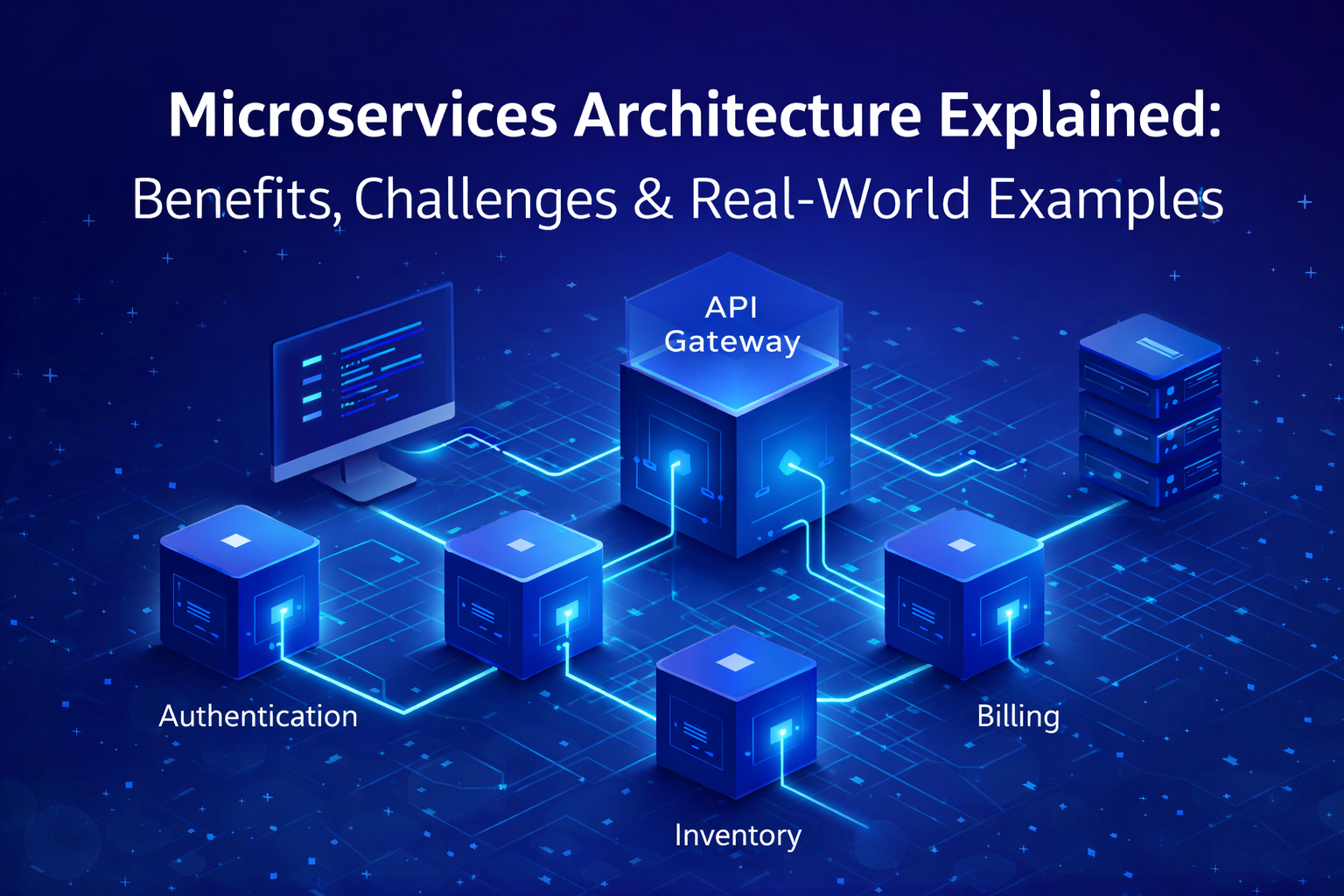
Client → API Gateway → Multiple MicroservicesEach service:
- Runs in its own process
- Can scale independently
- Has its own data storage
- Communicates with other services via REST, gRPC, or events
Core Characteristics of Microservices
1. Independent Deployability
Each service can be updated without redeploying the entire system.
2. Database Per Service
Services manage their own data to avoid tight coupling.
3. Decentralized Governance
Different services may use different technologies.
4. Fault Isolation
Failure in one service does not necessarily crash the entire system.
5. Automation & DevOps Culture
CI/CD, containers, and orchestration (like Kubernetes) are commonly used.
Communication in Microservices
Microservices communicate using two main approaches:
1. Synchronous Communication
- REST APIs
- gRPC
- Direct service-to-service calls
2. Asynchronous Communication (Event-Driven)
- Kafka
- RabbitMQ
- AWS SNS/SQS
Modern systems often use both.
Benefits of Microservices Architecture
Scalability
Scale only the services that need more resources.
Faster Development
Teams can work independently on different services.
Technology Flexibility
Each service can use different tech stacks.
Better Fault Isolation
A failure in one service doesn’t crash everything.
Improved Maintainability
Smaller codebases are easier to understand and manage.
Challenges of Microservices
Microservices introduce operational complexity.
Distributed System Complexity
You must handle:
- Network failures
- Latency
- Eventual consistency
Data Consistency
Traditional database transactions don’t work across services.
Patterns like Saga are used instead.
Monitoring & Observability
Requires:
- Centralized logging
- Distributed tracing
- Metrics monitoring
Deployment Complexity
Requires:
- Containers (Docker)
- Orchestration (Kubernetes)
- CI/CD pipelines
When Should You Use Microservices?
Microservices are ideal when:
- The system is large and complex
- Multiple teams are working simultaneously
- Independent scaling is required
- High availability is critical
Avoid microservices if:
- You are building an MVP
- The team is small
- The system is not complex
- DevOps maturity is low
Conclusion
Microservices architecture is a powerful distributed system design approach that enables scalability, flexibility, and independent deployments.
However, it comes with increased operational complexity and should be adopted thoughtfully.
For large-scale enterprise systems and high-growth platforms, microservices can unlock massive scalability and team productivity. For smaller systems, simpler architectures may be more effective.
Choosing the right architecture is a system design decision, not a trend to follow blindly.
